Tenant Rights vs Landlord Rights in India: Who Should Have More?
Explore tenant rights vs landlord rights in India, the Model Tenancy Act 2021, security deposits, eviction rules and fair rental housing.
By Rittam Debnath, Founder, Rentesy
Ask a tenant if renters need more protection and the answer comes fast. Ask a landlord the same question and the answer comes just as fast, in the opposite direction.
Both sides have good reasons. Both sides also tend to tell only half the story.
Tenant rights in India and landlord rights in India usually get framed as a fight: whose needs matter more? That argument goes nowhere. A better question is simpler. How do we protect someone from losing their home, while still letting an owner protect their property and their income?
That question matters to tenants, to landlords, to anyone writing rental rules, and to us at Rentesy.
Knowing how tenant protection laws in India work, and how landlord-tenant disputes usually get settled, helps both sides understand their rights and their options.
This is general information, not legal advice. Tenancy rules change from state to state, so check what applies where the property is.

Why this argument never really ends
Housing is not a normal purchase.
If you buy a bad phone, you return it. If your rented home is bad, you cannot just swap it out. Moving costs money. It costs time. Kids change schools. Commutes get longer. A new deposit lands on top of the old one.
So tenants stay in places that make them unhappy. They put up with a broken tap for six months. They accept a rent hike they cannot really afford. Not because they agree, but because leaving is harder than staying.
Landlords have their own version of this. A flat does not pay for itself. The loan comes due every month. The society charges come due every month. If the rent stops, the bills do not.
Both sides are exposed. Just not in the same way.
The case for stronger tenant rights
A home is not a gadget
 The strongest argument for tenant protection starts with a basic fact. People need somewhere to live.
A tenant with a few affordable options in the area has some power. A tenant with none has almost no power. That gap is where unfair things happen.
Think about a renter who has paid on time for two years. The ceiling starts leaking. She wants to complain. But she also wants to renew the lease. So she waits. Maybe the landlord fixes it. Maybe she lives with a bucket.
This is not rare. It is what happens when one side can walk away and the other cannot.
The costs pile up fast
Moving into a rental often means paying several things at once. First month's rent. Security deposit. Brokerage. Moving van. Maybe new furniture.
Then, at the end, the deposit comes back. Or it does not.
A withheld deposit can block the next move. The tenant has already found a new flat. But the money for that flat is stuck with the old landlord, with no clear reason given.
Rent increases hit differently. A tenant may have built her whole life around one area. Work, parents, a child's school. A big jump in rent can force a move she never planned for.
Clear terms, proper notice and a way to settle disputes would fix a lot of this. None of that gives tenants an unfair edge. It just stops the stronger side from using its strength.
The case for landlord rights
Not every landlord is a big investor
It is easy to picture a landlord as someone with twenty flats and a driver. Some are. Many are not.
Plenty of landlords own one extra flat. Or a small house. Or a property they inherited from their parents. Some are retired and live on the rent. Some are paying off a home loan and renting the flat to cover part of it.
For them, two months of missing rent is not a small annoyance. It is a real problem.
This does not cancel the tenant's need for a stable home. It just means the rules should not assume every owner has deep pockets.
When rent stops, the bills do not
Picture a landlord who rents out a flat and uses that rent to pay the EMI.
The tenant stops paying. The landlord still owes the bank. He still pays maintenance. He still pays tax. Meanwhile, getting the tenant out can take months, sometimes longer.
Damage adds another layer. Normal wear is one thing. A broken door, ruined flooring or a flooded bathroom is another. Fixing that costs money. Getting it back from a tenant can be hard.
Tenants should not be punished for what other tenants did. True. But landlords should also have a real way to recover when a serious breach happens.
Clear rules help the good landlords too
Most landlords are not looking for a fight. They just want to know where they stand.
When is rent due? Who fixes the geyser? What happens at renewal? How much notice is needed? When can the owner ask for the flat back?
If these answers are vague, small problems turn into big ones. And when renting out a flat feels risky, some owners stop doing it. Others raise the rent to cover the risk.
That is not a reason to skip tenant protection. It is a reason to design it well.
Is being a landlord a choice and being a tenant a necessity?
This is the sharpest version of the argument. A tenant needs a home. A landlord chose to rent out a property. So why should the investor's risk beat the renter's need?
There is truth in it. But only some.
Not every landlord chose the job. Some inherited a flat and rent it out because selling is complicated. Some are posted in another city and rent out their own home for a few years. Some became landlords by accident.
Tenants are not one group either. Some are scraping by. Others earn well and have plenty of choices.
So the real gap is not "landlord vs tenant". It is about who has options and who does not, in that specific deal.
That is the line that matters. How much power does each side actually have?
Housing is essential, so tenants need real safeguards. Property costs money and carries risk, so landlords need clear rights and a real way to recover. A fair system holds both ideas at once.
What happens if tenant protection goes too far?
The common worry is simple. If renting out a flat becomes too painful, owners will stop doing it. They will sell. They will keep the flat empty. They will leave the rental market.
If enough of them do that, fewer homes are available to rent. Rents go up. Everyone loses.
That worry is real. But the opposite worry is real too. Weak protection leaves renters open to unfair treatment, and those costs land on society, not just on the tenant.
Neither outcome should be assumed. It depends on the rules, the local market and what else is going on.
Does a landlord selling a flat shrink the housing supply?
Not in a simple way.
If the owner sells to someone who moves in, the flat still exists. It is just no longer rented. The total housing stock did not change. The rental stock did.
If the buyer is another landlord, the rental stock may not change at all.
So "homes in the city" and "homes available to rent" are two different numbers. Policy can move one without moving the other. That difference matters when people argue about supply.
Protecting tenants and adding homes are not enemies
These two goals can be chased at the same time.
Governments can do several things at once:
- Build more housing that people on normal incomes can afford.
- Improve public and social housing.
- Make rental agreements clear and easy to enforce.
- Give both sides a fast, cheap way to settle disputes.
- Make it easier for good landlords to run their properties properly.
- Check the rules against real data on rent, supply and outcomes.
The goal is not to squeeze landlords dry. It is not to leave renters at their mercy either. It is a rental market that works for both.
What does India's Model Tenancy Act, 2021 actually say?
The Model Tenancy Act, 2021 is a good place to start. It shows how a law can hold tenant and landlord interests together.
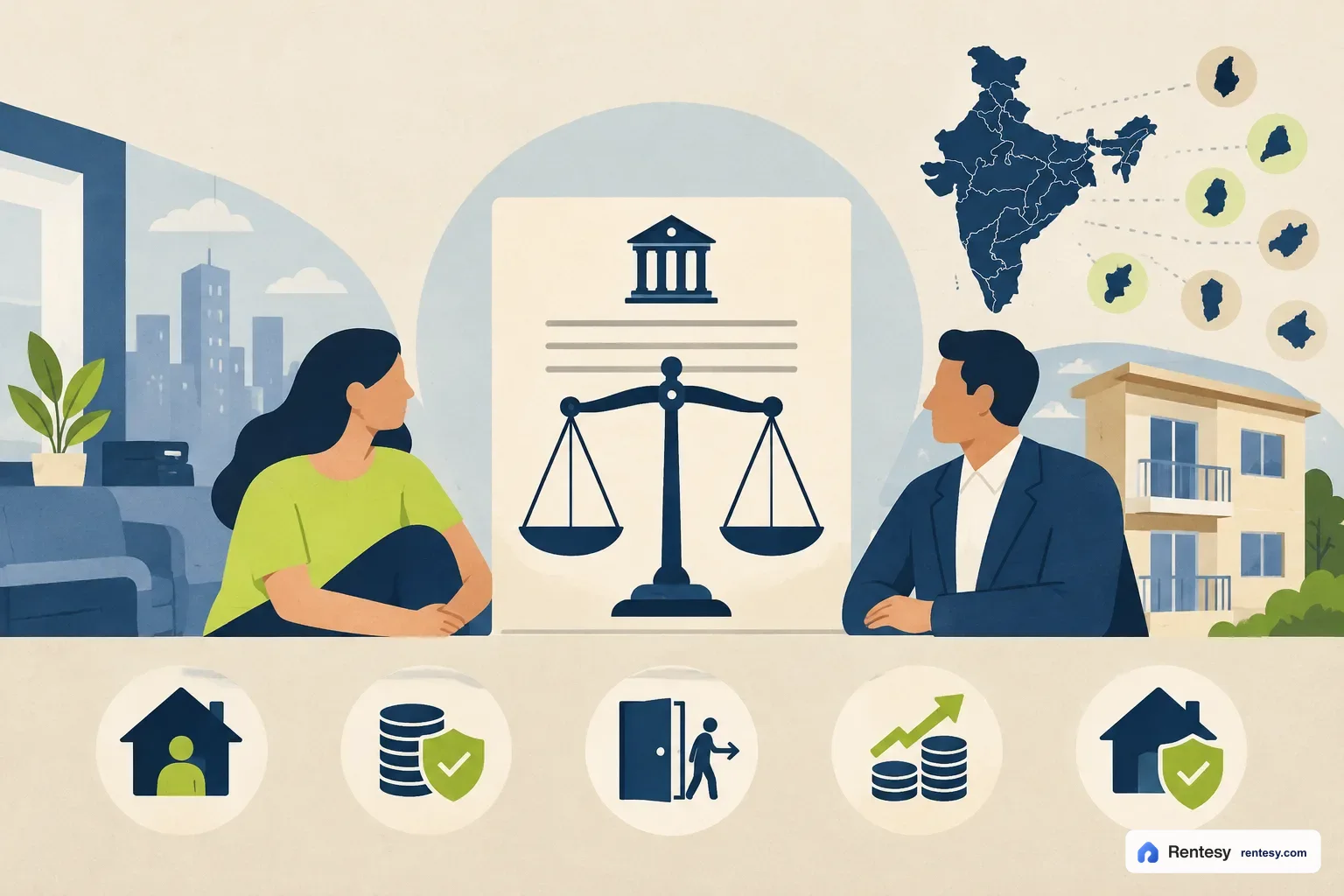 But first, one important point. It is a model law. It does not apply across India on its own.
States and Union Territories can adopt it, change it or ignore it. What actually applies to a tenancy depends on the law in that state. So treat the Act as a guide, not as your local rulebook.
Here is what it sets out.
Written agreements
Rental agreement rules in India start with one simple step: put the deal in writing. The model pushes for a written tenancy agreement that sets out the rights and responsibilities of tenants and landlords.
A written agreement cuts down on arguments about rent, deposit, repairs and notice. It also gives both sides something to point to later. If you want a deeper walkthrough, we have a full guide to rental agreements in India.
Security deposits
Security deposit rules vary by state. Every tenant should still know three things. How much deposit was agreed? What can be deducted? How does the refund work at the end?
The model caps the deposit at two months' rent for homes and six months' rent for commercial property.
That is the model. It is not a promise that every tenancy in India has the same limit. Check your state's law before you rely on it.
Rent revision
The agreement and the state law decide when rent can change and by how much. A clear clause avoids surprise increases and later arguments.
Maintenance
Landlord responsibilities in India are set by the agreement and the state law. Broadly, the owner handles big structural repairs, and the tenant handles small day-to-day fixes.
The model splits repair and maintenance duties between landlord and tenant. Written records of repair requests help both sides. Who asked for what, when, and what was done.
Disputes
The model sets up a structure with a Rent Authority, a Rent Court and a Rent Tribunal. The idea is to give people a clear route instead of a long, confusing fight.
Eviction
Tenant eviction laws in India depend on state law, the tenancy agreement and the facts of the case. A landlord cannot skip the legal process. A tenant cannot ignore a valid notice. Both sides should know the rules before a notice is sent or a moving date is set.
Adoption is the real test
A model law is only a framework. Its effect depends on whether states adopt it, how local rules are written, and whether the system actually works on the ground.
So check the rules that apply to your property. Do not assume every line in the Model Act applies to you.
For the official announcement, see the Press Information Bureau release on the Model Tenancy Act, 2021.
What tenants and landlords can learn from each other
Rights matter. But most tenancies are shaped by everyday behaviour, not courtrooms. A good relationship prevents more disputes than a good clause does.
Landlords who have kept tenants for years tend to do a few simple things.
Fair rent keeps good tenants
Some landlords charge a little below the top of the market. They avoid raising rent every year for a tenant who pays on time and treats the flat well.
Why? Because an empty flat costs money too. There is the lost rent, the ads, the visits, the screening, the repainting. A steady tenant at a fair rent can be worth more than a slightly higher rent with gaps between tenants.
For tenants, the lesson is simple. Talk about renewal and rent early, not a week before the lease ends.
Quick repairs build trust
A landlord who fixes things quickly shows they take their side seriously.
Tenants then report problems early. A small leak gets fixed before it becomes a big one. Everyone saves money.
Slow repairs do the opposite. The flat gets worse. The tenant gets angrier. A simple system for logging and tracking repair requests fixes this for both sides.
Talk before the last minute
Some landlords reach out about 60 days before renewal. They ask if the tenant plans to stay and what would help.
The right notice period depends on the agreement and the law. But the habit is a good one. Tenants get time to plan. Landlords get time to prepare for a possible vacancy.
Respect runs both ways
A good landlord does not treat every repair request as a nuisance. A good tenant does not treat the flat or the agreement carelessly.
Clear expectations, polite communication and fixing problems early do not replace legal protection. They just mean fewer disputes ever reach that stage.
How software can make renting fairer
Most rental fights come down to missing records. A message lost in a chat. A promise nobody wrote down. A payment with no receipt.
Software cannot remove every conflict. But it can make the facts easy to see.
Here is where a good rental platform helps.
Digital agreements
One stored copy of the agreement means both sides can check the rent, the term, the repairs and the renewal terms at any time. Access should be limited to the people involved.
Rent records
A clear payment history helps tenants prove what they paid. It helps landlords spot what is missing. Receipts with dates settle most arguments before they start.
Deposit records
Record the amount, the date, the condition of the flat and any agreed deductions. Photos at move-in and move-out help both sides judge the property fairly.
Repair tracking
A maintenance log records the issue, the date, who is handling it and when it is done. Requests stop vanishing into phone calls. Both sides see the same status.
Renewal reminders
Early reminders give both sides time to talk, agree or prepare to move. Landlords can plan for a vacancy. Tenants can plan their next step.
This is the kind of work we build for at Rentesy. We have written about the full process in our guide to managing a rental property in India.
The point is not to help one side win. It is to make the whole relationship easier to trust.
What would a fair rental system look like?
Start with the fact that tenants and landlords want different things. Then write clear rules for both.
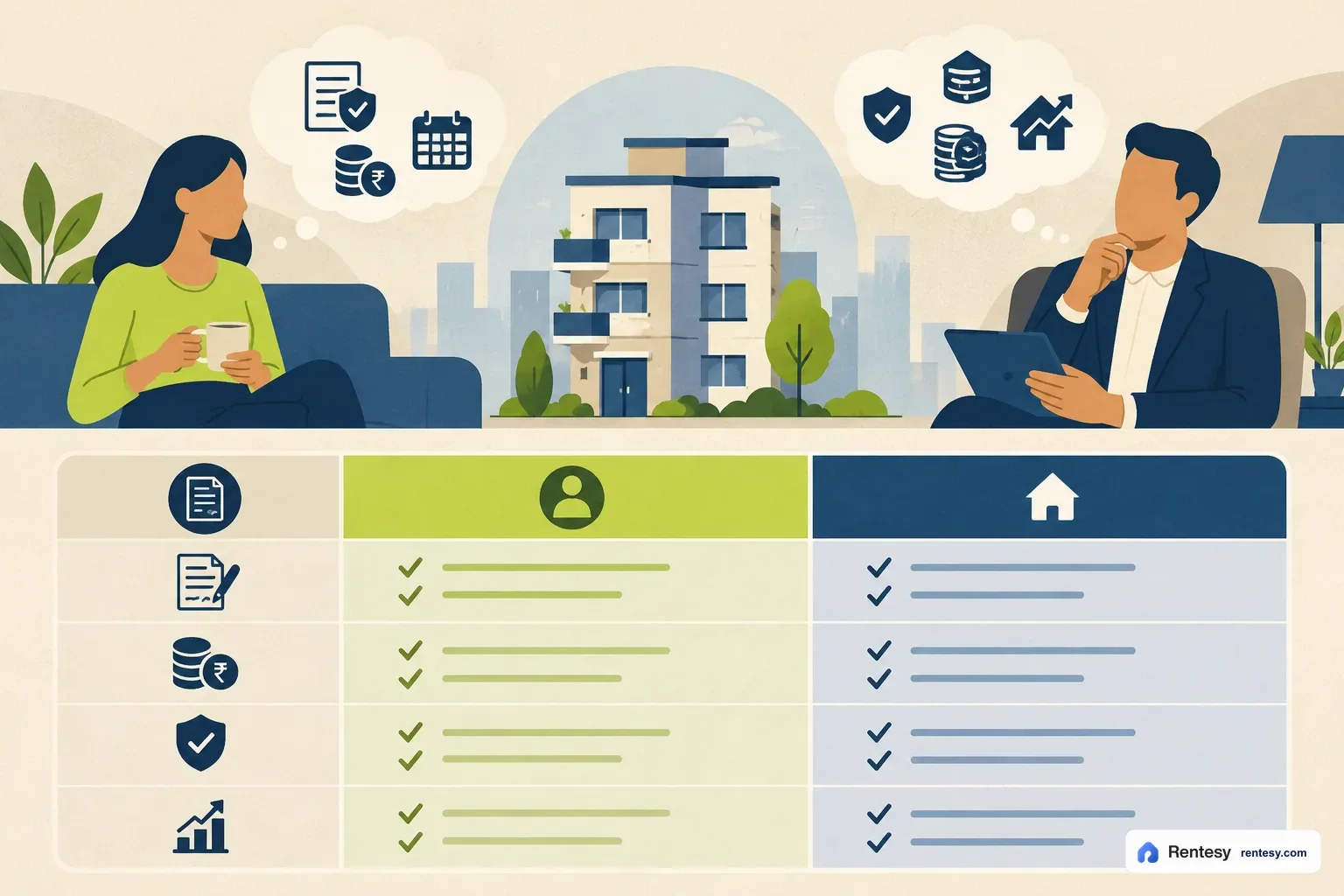
| Area | What tenants need | What landlords need |
|---|---|---|
| Agreement | Clear terms, no surprise changes | Terms that can be enforced |
| Rent | Clear amounts, due dates and receipts | On-time payment, a real way to recover unpaid rent |
| Deposit | Fair deductions and quick refunds | A fair way to recover proven costs |
| Repairs | A safe home and fast responses | Clear duties and no avoidable damage |
| Ending a tenancy | Proper notice and no illegal eviction | A lawful, practical way to get the property back |
| Disputes | A cheap, easy way to be heard | Timely hearings and decisions that stick |
| Renewal | Enough time to plan | A good idea of what comes next and time to find someone new |
The exact rules differ by state. Not every good practice is a legal duty. But the shape is the same everywhere.
A fair system also says two things clearly. A tenant's need for a home does not excuse unpaid rent or damage. And a landlord's ownership does not excuse illegal eviction, unfair deposit cuts or ignored repairs.
Fairness is not treating every case the same. It is clear rules, fair protection and a real way to fix things when either side does wrong.
The short answer
Should tenants have more rights than landlords?
The honest answer is that the question is slightly wrong.
Tenants deserve strong protection because losing a home hurts in ways that go far beyond money. Landlords deserve strong protection because they carry real costs and real risk.
The better aim is a system that gives each side what it needs. Safety for the tenant. Security for the landlord. A clear path when things go wrong.
Governments also need to tackle the price and supply of housing. Rental rules alone cannot fix that.
And both sides have a part to play. Fair rent. Fast repairs. Clear records. Early talks about renewal. Plain, polite communication.
For a tenant, a home is more than someone else's investment. For a landlord, a property is more than a service someone else uses.
A good rental market holds both truths at once. Tenants live with security. Landlords manage with confidence. And when something goes wrong, both sides get a fair hearing.
That is a better goal than winning the argument.
Rittam Debnath, Founder, Rentesy
Rittam is the founder of Rentesy, building property management software for landlords and property managers in India. He writes about renting, lease management and running rental portfolios.
Related articles

How to Retain Good Tenants: 10 Practical Strategies for Landlords in India
See Rentesy in action
Get a personalised 30-minute walkthrough for your portfolio. No commitment, no credit card.
Prefer email? Contact our team