
Property Management
Property Management12 min read
An NRI Landlord's Experience: How a Missing Electricity Bill Revealed a Property Management Problem
A real-life experience in Hyderabad shows how missing electricity bills, paper-based processes and communication gaps can affect NRI landlords, and how better property management can help.
By Rittam Debnath, Founder, Rentesy
Read summarized version with:
I didn't expect an electricity bill to teach me anything about property management. But that's exactly what happened the last time I was back at my building in Hyderabad.
If you own a rental property in India and live abroad, you'll probably recognise this story. Rent comes in. Tenants seem settled. From a distance, everything looks fine. Then you visit, and all the small things you never hear about come out at once.
Here's what happened, what I got wrong, and what I'd tell any NRI landlord managing a property from another country.

Key takeaways
- Small gaps become big problems. A bill that never reaches the tenant can turn into missed payments and a cut electricity supply.
- Don't assume tenants will coordinate. Decide who receives bills, who shares them and who confirms payment.
- WhatsApp helps, but it isn't a system. Messages get buried, and a shared bill isn't a paid bill.
- Build a process that survives people leaving. One helpful tenant is a patch, not a fix.
- Smart meters are only part of the answer. Digital billing improves access, but someone still owns communication and payment follow-up.
- Software can carry the follow-ups. Shared documents, reminders and tracked requests mean fewer things depend on your memory.
It started with one question: "Where is my electricity bill?"
Several families rent flats in my building. When I turned up, a few of them realised I was the owner and started telling me about the things that had been bothering them. Most of it was minor. One complaint wasn't.
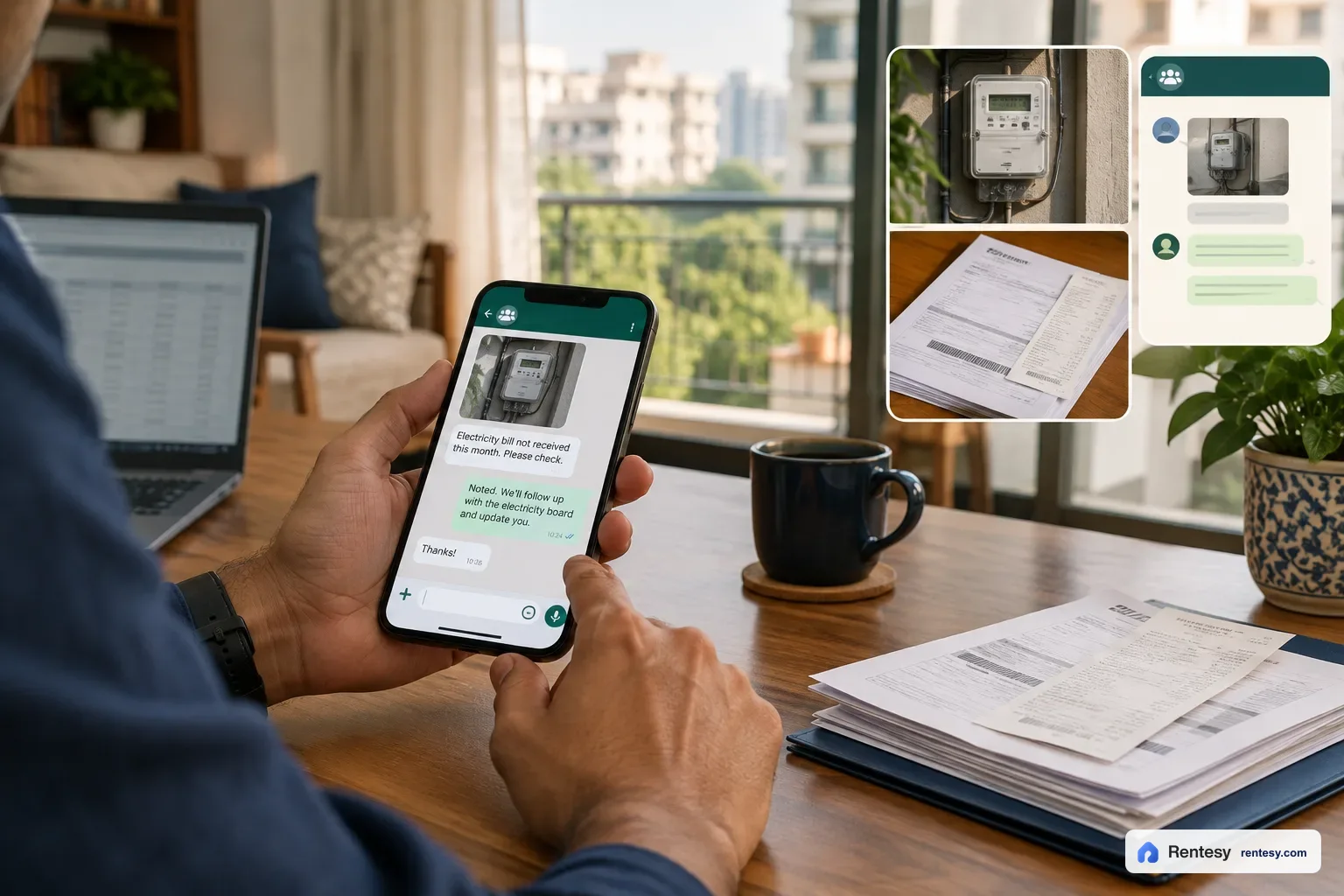
A tenant told me they hadn't received an electricity bill in three months. Their power had also been cut more than once in that time.
My first thought was that the electricity board had a problem, or that a payment had gone missing somewhere. The real reason was far more basic.
The bills were still being delivered on paper. If a tenant happened to be home, the bill was handed over. If nobody was around, it was left near the meter on the ground floor. Someone had to notice it, pick it up, work out whose flat it belonged to and get it to them.
Nobody owned that job. So some months, nobody did it.
The tenant wasn't refusing to pay. They had no idea how much to pay or by when, because the bill never reached them. Leave that long enough and the supply gets disconnected.
Why this hits NRI landlords harder
If you live in the same city as your property, this is a ten-minute problem. You drop by, ask around, and sort it out.
From another country, you don't know a bill has arrived. You don't know a tenant hasn't received it. You don't know the same thing has happened three months in a row. You hear about it only when someone is fed up enough to complain, and by then they've already lost power.
Looking back, three things made this possible.
Paper processes depend on people
There's nothing wrong with a paper bill. The trouble is that getting it from the meter to the right flat relied on whoever happened to walk past. No one tracked whether the handover actually happened, so there was no way to know when it didn't.
Tenants don't naturally coordinate
My tenants come from different parts of the country and speak different languages. They're polite to each other, but they don't have a reason to talk every day. Even when someone picked up the bills, there was no reliable way for them to tell the others.
That was my biggest wrong assumption: that people who share a building will share information. They won't, unless you set it up.
Only the owner sees the whole picture
One tenant mentioned a missing bill. Another mentioned a power cut. Someone else had noticed envelopes piling up by the meter. On their own, those sound like three unrelated gripes. Put together, they describe one broken process.
The owner is usually the only person who hears all three. If you're thousands of kilometres away, you often don't.
What I did about it
I fixed the immediate problem in two steps. Neither is clever, and that's the point.
I gave one person the job
I asked one tenant to collect the electricity bills whenever they arrive and pass them on to the others. That single change moved the task from "everyone" to "someone", and things improved immediately.
It's still a patch. If that tenant travels, moves out or simply forgets, we're back where we started.
I set up a WhatsApp group for the building
I created a group with all the tenants. Now a photo of each bill goes in as soon as someone has it, so everyone can see the amount and the due date even if the paper copy never reached them. Payment confirmations and receipts go in the same place.
It gave me a direct line to the building without being there, and it gave tenants a second way to get the bill.
But WhatsApp has limits I ran into quickly. Messages scroll away. Finding last quarter's bill means scrolling through months of chat. And posting a bill tells me nothing about whether the right person saw it, let alone paid it.
A channel is not a process. I had the channel. I still needed the process.
Four lessons I'd pass on
Separate the communication from the responsibility
Sharing a bill and making sure it gets paid are two different jobs. Write down who receives the bill, who distributes it, who pays and who follows up when payment isn't confirmed. Otherwise everyone quietly assumes someone else has it covered.
Keep documents in one place
Bills, receipts, invoices, repair records and tenancy papers shouldn't live only in message threads. One organised place makes it easy to pull up an old bill or check what happened the last time a problem was reported. The more flats you manage, the more this matters.
A message is not a completed task
Sending a bill to the group doesn't mean the tenant has it. Sending a repair request to a plumber doesn't mean the repair is done. You need a way to see each item move from "raised" to "resolved".
Fix the process, not just the problem
Nominating one tenant solved the week's problem. A process that still works when that tenant leaves solves the year's problem. Whenever the same complaint shows up twice, ask what repeatable step would stop it, instead of leaning on someone's memory.
What NRI landlords should do, and what to avoid
You don't need to automate everything on day one. Start with the recurring tasks that cause the most trouble.
Do this
Set up one reliable channel. Tenants need a clear way to report problems and receive updates. A WhatsApp group is a fine start if everyone knows what it's for.
Keep digital copies of bills and receipts. Where your electricity provider offers online billing, register for it and use the official app or portal rather than relying on the paper copy alone.
Spell out payment responsibilities. Who pays each utility, how the amount is worked out and how proof of payment is shared. Put it in the agreement or at least in writing.
Agree on what happens when a bill goes missing. Someone should know how to get a duplicate bill or check the outstanding amount with the provider before the due date passes.
Have a trusted person on the ground. An authorised representative or a property manager for anything that needs a physical visit. Make sure tenants know how to reach them.
Watch for repeat complaints. The same electricity complaint could be delivery, responsibility, account details or a genuine supply fault. Find out which before you fix the wrong thing.
Avoid this
Assuming tenants will coordinate on their own. Even good tenants have different schedules and habits.
Using WhatsApp as your permanent record. It's good for talking, poor for tracking deadlines, payments and open issues.
Assuming an unpaid bill means an unwilling tenant. Check whether the bill arrived, whether the amount is right and whether the payment route is clear first.
Sharing more than you need to. Account numbers, ID documents and financial details should only reach the people who need them.
Expecting a smart meter to fix everything. It helps with data and billing access, but someone still has to own communication and follow-up.
Will smart meters solve this in India?
Smart meters and digital billing reduce the dependence on paper, but what you actually get varies by city, utility and building.
It helps to separate three things that often get lumped together:
- Smart metering. The meter sends consumption data to the utility.
- Digital billing. The bill is available online, through an app, a portal or a message.
- Property management. Someone identifies the right bill, knows who is responsible, tracks whether it's paid and resolves problems.
The first two make the third easier. They don't replace it. A smart meter doesn't give every tenant access to the account, and it won't message the landlord when a payment is overdue.
For older buildings, shared connections or places where digital access is patchy, you'll still need a practical process at the property level. Use the official digital channels wherever they exist, and run a simple, reliable routine for everything else.
Where Rentesy fits
This experience is a big part of why we're building Rentesy the way we are. The hard part of managing a property from abroad isn't the big decisions. It's the small, recurring tasks that fall through the cracks when they depend on informal arrangements.
Here's how the problem maps to what the software does today, and where we're still heading.
One place for documents
Electricity bills, receipts, agreements and repair records live in one organised place instead of a chat history. Tenants see what's relevant to their flat, and nothing else.
Reminders with due dates
Record a bill with its due date and the right tenant gets notified, with a reminder before the deadline. If a payment is confirmed, the record updates. If it isn't, the reminder goes out again or the issue is flagged for a human.
One honest caveat: recording a bill doesn't prove it was paid. That needs a receipt, a verified payment, or someone confirming it. Automation should ask for that evidence, not assume it.
Tasks with an owner and a status
Collecting the paper bill each month can be a recurring task assigned to an authorised person, with a deadline and a status. If it isn't done, it escalates to the owner. That's the difference between "a helpful tenant usually does it" and a process you can rely on.
A proper channel for problems
Tenants raise missing bills, power cuts and repairs through a structured request rather than a message that scrolls away. You see what was raised, what was done and whether it's closed, from any time zone.
Where this is heading: agentic property management
The next step is for the software to do more than remind. That's where AI agents come in. Imagine an authorised agent that notices an expected bill hasn't been uploaded, checks who is responsible, requests it, shares it with the right tenant when it arrives, tracks the due date, asks for payment confirmation and flags anything unresolved for you to look at.
Two rules matter here. The agent should never assume a missing document means a tenant hasn't paid; it should find out what's known, what's missing, and ask. And it should never touch a utility account, make a payment or change a service without explicit authorisation.
The goal isn't to take the owner out of every decision. It's to make sure routine tasks don't rely on the owner remembering every detail and chasing every person involved.
The bigger point
This started with one electricity bill, but the same pattern shows up everywhere in remote property management. A repair that stalls because nobody knows who owns it. A rent receipt lost in a thread. A lease quietly expiring because no one started the renewal conversation. The same building fault reported separately by three tenants, so nobody realises it's one problem.
For NRI landlords, each of these costs more than it should, because fixing it means coordinating people across distance and time zones. Clear responsibilities, shared records and well-designed automation shrink that cost.
Software won't stop bills arriving on paper or pipes leaking. What it can do is show you what needs attention, make clear who is responsible and let you confirm when something is actually resolved.
Final thoughts
I went back to Hyderabad expecting a routine visit, not a lesson in operations. The fix was simple: one person owns the bills, and a group where everyone can see them. That closed the gap. It also showed me how fragile a process is when it depends on paper, goodwill and people remembering.
If you manage property from abroad, don't wait for a small issue to become a complaint. Set clear responsibilities, keep records where everyone can find them, and establish a dependable way to communicate. Then automate the recurring parts where it's practical and safe.
That's what we want Rentesy to be for owners like me: a way to run a property with real visibility, even from thousands of kilometres away.
RD
Rittam Debnath, Founder, Rentesy
Rittam is the founder of Rentesy, building property management software for landlords and property managers in India. He writes about renting, lease management and running rental portfolios.
Find Rittam on LinkedIn.
Related articles

Property Management
AI Agents for Property Management: What They Are and Why They Matter

Property Management
How to Retain Good Tenants: 10 Practical Strategies for Landlords in India
See Rentesy in action
Get a personalised 30-minute walkthrough for your portfolio. No commitment, no credit card.
Prefer email? Contact our team