
AI & Automation
AI & Automation22 min read
What Is AI Property Management? A Practical Guide for Rental Teams
AI property management uses software to answer portfolio questions and run rent, tenant, maintenance and lease workflows. A practical guide to what it can do.
By Britney Lim, Real Estate & Commercial Leasing Writer
Read summarized version with:
Ask a property manager what they did yesterday and you'll hear the same list you'd have heard five years ago. Chased two tenants. Sent a receipt. Called a plumber. Checked whether a lease actually ends next month. Updated an owner who wanted a number before lunch.
None of that is hard work. All of it is repetitive, and it arrives in the middle of the work that does need judgement. AI property management is the attempt to take that list apart and hand the repetitive pieces to software, while keeping the decisions with a person.
It is not a chatbot bolted onto an old system. At its best, it is a layer that reads the records you already keep, carries a task through several steps, and stops before it changes anything you haven't approved.
This guide covers what the category actually means, the problems it is trying to solve, the use cases that hold up today, the ones that need caution, and a way to adopt it without losing control of your records.

Key takeaways
- AI property management is a workflow layer on top of a property management system. Without clean records underneath, there's nothing reliable to work from.
- The strongest use cases are repetitive, well documented and reversible: rent follow-ups, tenant questions, maintenance triage, renewals, reporting and imports.
- Adoption is rising fast, but most firms are using AI to do existing tasks faster rather than changing how the work flows. That's why productivity gains often don't show up in net operating income.
- Approval-first design is the difference between a useful system and an unsafe one. Every write should be a proposal a person can reject.
- AI should not decide tenant screening, evictions or legal outcomes on its own. Those need a person, a policy and a paper trail.
- Start with one workflow. Measure it for 30 days. Expand only if the result is obvious.
What AI property management actually means
Property management software has three layers, and people use the same words for all of them. Worth separating them before you buy anything.
The record layer. Properties, units, tenants, leases, charges, payments, vendors, work orders. If this layer is incomplete, every layer above it inherits the gap. Most disappointing AI projects in this industry are really record problems wearing a model as a disguise.
The automation layer. Rules that fire on a schedule or an event. Rent reminders before the due date. Late fees after a grace period. Renewal alerts at 90, 60 and 30 days. Automation follows a script, which is what you want for most recurring work: it's predictable, cheap and easy to audit.
The agent layer. An agent works toward a goal instead of running a script. Ask which tenants are behind on rent and it can check the ledger, work out who's overdue, look at each tenant's payment history, draft the follow-up and stop before sending. It chooses the steps at runtime. That's the part a rule can't do.
A table makes the difference concrete:
| Layer | What it does | Example |
|---|---|---|
| Record system | Stores the facts | The lease says rent is due on the 5th |
| Automation | Fires a fixed rule | A reminder goes out on the 3rd |
| Agent | Reasons across steps | Checks who paid, drafts the right follow-up, flags the exception |
Agentic AI is the current label for the third layer. The useful version isn't autonomy for its own sake. It's a system that can carry a task through several steps while staying inside permissions and stopping at the decisions a person should own.
Why property management is a good fit for AI
Property management is full of work that is repetitive, time-sensitive and low in variation. An agent is good at exactly that shape of work.
The same five questions arrive every week. Rent due dates, receipts, repair status, lease terms, deposit rules. The same follow-ups go out every month. The same dates need watching every year. None of it is intellectually hard. There's simply a lot of it, and it doesn't stop when the office closes.
The expectations around that work are rising. Buildium's 2027 industry report found that 43% of rental owners judge managers mainly on communication speed, 84% of renters expect a response within 24 hours and 61% expect same-day service. Renters who are satisfied with communication are 58% more likely to renew. Speed isn't a nice extra in this business. It's part of retention.
Teams are thin, too. Buildium found that 70% of property management firms expect to keep team size flat while 64% plan to expand their portfolios. That arithmetic only works if the repetitive work goes somewhere other than another hire.
The problems AI property management is trying to solve
AI isn't valuable in the abstract. It's valuable when it removes a specific recurring friction. These are the ones that show up in almost every rental operation.
1. The record is fragmented
The tenant's ID scan lives in an email thread. The signed lease sits in a folder. The maintenance request is in a group chat. The deposit is in a notebook. The rent ledger is a spreadsheet that only one person understands.
Nothing is lost until someone needs it. Then every answer takes ten minutes of searching, and the answer depends on who you ask.
AI can't fix a fragmented record by itself. What it can do is make the system of record the place the work happens, so each question and each action leaves the record a little more complete instead of a little more scattered.
2. Rent follow-up is manual
Sending one reminder is easy. Sending the right reminder to the right tenant, at the right point in the delinquency cycle, across a portfolio with different due dates, is not. Most managers either chase everything by hand or send one generic reminder and hope.
An agent can check who has paid, who has part-paid and who hasn't responded, then draft the next follow-up for each group. The manager reviews the drafts and decides who needs a call instead of a message.
3. Tenant questions repeat
Where do I pay? When is rent due? Can I get a receipt? Is the plumber coming today?
The answers sit in the lease, the ledger and the work order. Someone still has to find them and type them out. This is the most common use of AI in property management today: Buildium found resident communication and support was the top use at 48% of firms surveyed.
4. Maintenance coordination leaks
A tenant reports a leak. The message goes to a plumber. The quote is approved in another chat. The invoice arrives a month later. By then nobody agrees on what was fixed or what it cost.
The repair was small. The trail is not.
AI helps most at the front of that workflow: classify the request, suggest the right trade, recommend a vendor whose contact details are actually on file, and prepare the work order. The person still approves the spend and owns the vendor relationship. That part shouldn't move.
5. Renewals are discovered late
A lease ends in 30 days and nobody noticed. The tenant has already signed somewhere else. Every week a unit sits empty is rent you don't get back.
An agent can list every lease ending in the next 30, 60 or 90 days, prepare the renewal outreach and flag the ones that need a decision. The manager still sets the new rent and handles the negotiation.
6. Reporting is a reconstruction
At the end of the month someone exports transactions, matches them in a spreadsheet, adds the deposit balances and writes an owner update. The numbers are usually right. The process is slow, and it produces a historical document rather than a current view.
AI can answer portfolio questions straight from the ledger: rent collected this month, outstanding rent, deposits held, vacant units, leases expiring. Reporting becomes a conversation instead of a reconstruction. The manager still checks the numbers before they go to an owner.
7. Data lives in the previous software
Moving from a spreadsheet or another platform is one of the most expensive parts of adopting property management software. Someone has to map columns, catch duplicates, decide what to do with incomplete rows, and avoid importing a lease that ended three years ago.
An agent can inspect the spreadsheet headers, propose a mapping, surface ambiguity and stage the import. The manager still confirms every decision. It's one of the cleanest examples of AI doing useful work without touching the live record until a person approves.
8. Governance is an afterthought
AI adoption is outrunning AI policy. IREM and AppFolio's 2026 survey of 3,662 professionals found that 85% of AI users report productivity gains, but only 48% report a positive impact on NOI. Only 8% of organizations had a written AI policy, and 74% of professionals had received no formal training.
That gap isn't a reason to wait. It's a reason to choose tools with visible permissions, an approval step and an audit trail, and to write down who is allowed to approve what.
Twelve use cases that work today
The examples below are illustrative, not customer stories. They describe the shape of the workflow, not a claim about a specific portfolio. Each one maps to a problem above.
1. Rent reminder sequences
Six days late, no reply. The agent checks the lease, the ledger and the last reminder, then drafts a short follow-up in the manager's name.
If the tenant has a good payment history, the tone is softer. If this is the third month in a row, the draft says so and suggests a call. The manager edits and sends, or rejects it and calls instead.
2. Payment reconciliation
A bank credit arrives without a reference. The agent matches it against open charges, flags the most likely unit and leaves the transaction visible as unmatched until someone confirms.
That's where AI helps most in accounting: not by posting entries on its own, but by shrinking the list a person has to review.
3. Tenant questions grounded in the record
"When is the plumber coming?" The agent reads the open work order, the scheduled slot and the assigned vendor, then drafts a reply with the actual date and time. A pet question is answered from the lease clause, not from a generic script. If the question falls outside policy, it goes to a person with the conversation attached.
4. Maintenance triage and vendor dispatch
A photo of water under the kitchen sink. The agent classifies it as plumbing, marks it urgent, finds the unit, checks which vendors have a phone or email on file, and proposes a work order with a due date.
A gas smell or a live electrical fault should go to a person immediately. Not everything belongs in a queue.
5. Lease renewal pipeline
The agent lists leases expiring in the next 90 days, separates the ones with a renewal conversation already open from the ones with no contact, and drafts the first outreach for each. When the tenant replies, the manager records the new terms and the old lease stays as history.
The missing step in most operations isn't the offer. It's starting the conversation early enough.
6. Critical date monitoring
Escalations, lock-in end dates, notice deadlines and renewal windows are all dates in a document nobody watches. An agent can turn them into a short list of actions for the month and prepare reminders before each one. The manager decides what happens on the date.
7. Move-out and deposit reconciliation
A tenant gives notice. The agent pulls the move-in inspection, the deposit record, any unpaid dues and the final meter readings, then prepares a reconciliation for review. The deposit stays a liability until the manager approves the deductions and the refund.
8. Owner reporting and portfolio questions
An owner asks how the property performed last month. Instead of exporting a spreadsheet, the manager asks for collected rent, expenses and the net position, checks the answer against the ledger, and sends it. The agent can prepare the written summary in the manager's voice. The owner relationship still belongs to the manager.
9. Calendar and scheduling
An inspection needs a time that works for the tenant and the assignee. The agent checks the calendar, proposes a few clash-free slots and prepares the event. Someone picks a slot and confirms.
Scheduling is a good early use case because the cost of a wrong draft is low and the time saved is immediate. It also gets the team used to reviewing agent work before the stakes rise.
10. Importing from other software
A new customer arrives with three spreadsheets, four sheets in each file and inconsistent column names. The agent inspects headers, proposes a mapping, flags ambiguous dates and duplicate tenants, and stages the data.
The manager reviews the mapping and confirms before anything is written. Imported leases stay as drafts until someone activates them. That last detail matters more than it sounds: it gives you a chance to check the data before it starts billing anyone.
11. Communication with a paper trail
Every drafted email, approved work order and corrected lease date should leave a record of who proposed it, who approved it and when.
Less exciting than the drafting? Sure. But this is what makes AI usable in a business where money and legal terms are involved.
12. Market and policy research
A manager needs the stamp duty in a state, the notice period for a particular tenancy, or the going rent in an area. An agent with web access can look it up and cite the source.
Useful, as long as the answer is clearly separated from portfolio data and anything that affects a legal document gets checked by a person.
What Rentesy does today
Rentesy is a property management platform with an AI operations assistant called Super. The order of operations is the point: Super reads from the same records the team already uses, and every change is a proposal until a person approves it.
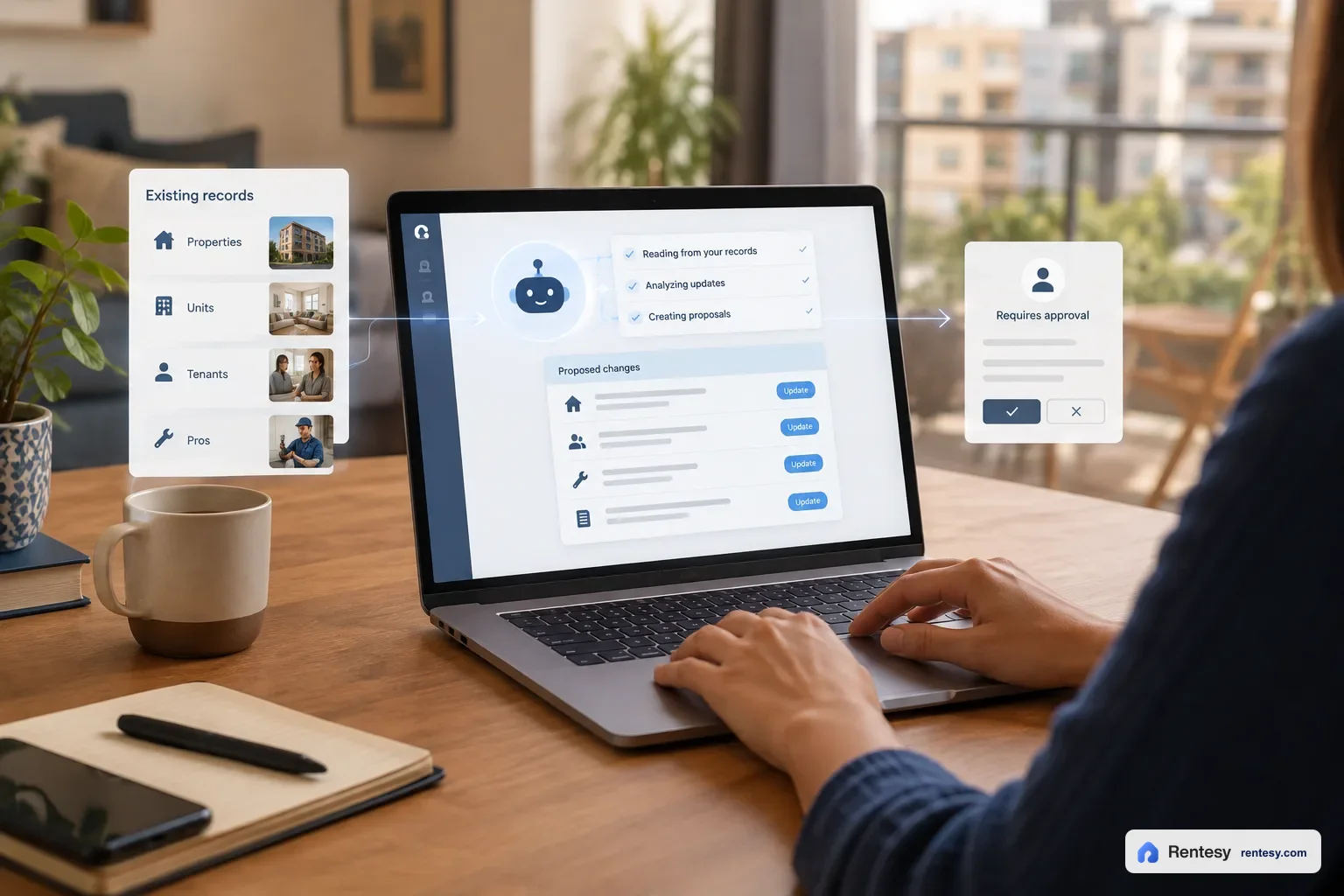 The manager portal today holds properties and units, tenants and prospects, owners and vendors, active and draft leases, rental applications, rent charges and payments, accounting records, maintenance requests and work orders, announcements and messages, signature requests, calendar events and reports. That record is the foundation. Super works inside it instead of in a separate chat database.
In practice, you open the Super tab and ask something like "who's late on rent at Blue Heavens?" You get a table of the tenants and a short answer. If you want to do something about it, you ask for the follow-up, review the draft on a card, and press Send. If the draft is wrong, you edit it or reject it. Nothing happens until you do.
What Super can do today:
- Answer portfolio questions such as how many units are vacant, which leases expire in the next 30 days, how much rent was collected this month and how much is outstanding.
- Look up a tenant, lease, vendor or property, including rent and balance facts.
- Draft tenant emails from scratch or from a saved template, for the manager to review and send.
- Propose work orders with a recommended vendor, due date and priority, after checking contact details.
- Propose vendor records and contact updates.
- Propose a corrected lease end date when the record is wrong.
- Prepare calendar events and lease reminder checklists.
- Review imports from other software and stage the mapping and decisions.
- Search the public web for questions the portfolio data cannot answer, with citations.
What it doesn't do today:
- Send emails, dispatch vendors or change records without approval.
- Edit arbitrary fields or delete records.
- Send SMS or WhatsApp messages yet.
- Make tenant screening, eviction or legal decisions.
- See data the person using it isn't already allowed to see.
That last point isn't a limitation to work around. It's the design. The assistant inherits the same role-based permission scope as the person using it, and every write is reviewable. For a business that handles rent, deposits and legal agreements, an assistant you can't audit isn't an assistant. It's a liability.
If you want the product view, see Super, the AI property management software layer, the full property management platform, and the workflow pages for rent collection, tenant management, maintenance, lease management and accounting.
Where AI should not be in charge
The fastest way to damage trust in AI property management is to let it make decisions it shouldn't make.
Tenant screening and selection. Screening involves protected characteristics, local fair housing rules and a paper trail. AI can help collect documents and summarise what was submitted. It should not score applicants or decide who gets the unit. In the United States, fair housing exposure is real. In India, the Digital Personal Data Protection Act, 2023 adds obligations around how personal data is collected, stored and used. Get advice for your jurisdiction before automating any part of this decision.
Evictions and legal notices. The wording and timing depend on the lease and local law. A model can draft a first version. A person has to review it and own it.
Money movement without approval. Reading a ledger is low risk. Moving money is not. Any payment initiation needs explicit human approval and a clear audit trail.
Sensitive data without least privilege. An assistant should only see what the person using it can see. Role-based access, vendor data processing terms and a written policy matter more than the model choice.
Unverified facts. A model that invents a balance, a date or a vendor is worse than no assistant at all. Answers should come from the records, web answers should carry sources, and the manager should be able to see which record produced which fact.
How to evaluate AI property management software
Use this checklist before you buy.
- Does it sit on your system of record? If the assistant needs a separate export, you'll be maintaining two versions of the truth.
- Does it ask before writing? Every change should be a proposal with an approve or reject step. Ask to see the audit trail.
- Does it inherit permissions? The assistant shouldn't become a back door around role-based access.
- Can you see the source of each fact? A balance should trace to a ledger. A lease date should trace to a lease. A web answer should cite a source.
- What happens when it's wrong? Look for rejection, editing, stale checks and an undo path. A system with no undo is a system you can't safely test.
- Does it handle imports? Moving data in is where many projects fail. Staged imports with explicit decisions beat a bulk write.
- What does each action cost? Some tools charge per message, per credit or per model call. Understand the unit before you scale a workflow.
- What's the fallback? When the model is unavailable, can your team still work? The answer should be yes.
A 30-day adoption plan
Week 1: audit the work. List the tasks your team repeats every week. Count how long they take. Check whether the underlying records are complete enough for a system to work from. Poor data is the first thing to fix, not the model.
Week 2: pick one workflow. Rent follow-ups, tenant questions or maintenance triage are the usual starting points. They have clear inputs, a measurable output and a low cost when a draft is wrong. Write down who can approve what.
Week 3: run it in review mode. Use the assistant to draft, but have a person approve every action. Measure three things: time saved, quality of the draft and the number of exceptions. Don't expand yet.
Week 4: review and decide. If the workflow is faster and the error rate is acceptable, keep it and add a second workflow. If not, fix the data or the process before adding more surface area.
The most common mistake is rolling out five workflows at once and learning nothing from any of them.
India-specific considerations
The global workflow is the same. The details differ.
UPI and recurring mandates. Indian tenants expect UPI, and UPI AutoPay is the closest thing to automatic rent. Any AI workflow that touches rent collection needs to understand mandates, failures and expiries.
WhatsApp-first communication. Much of the market runs on WhatsApp. AI can draft the message and prepare the follow-up, but sending still needs a compliant business messaging setup. Don't assume a chat model equals a WhatsApp integration.
PG and co-living billing. Bed-level billing, split dues, electricity submeters and high turnover make PG operations different from apartment rentals. The assistant should work from a record that models beds and residents, not just units.
Aadhaar, KYC and DPDP. Identity documents are sensitive. Store them in a system with access controls, not in chat threads. India's Digital Personal Data Protection Act, 2023 sets obligations for personal data handling. This is general information, not legal advice. Ask a qualified professional about your obligations.
GST, TDS and HRA. Commercial tenancies may need GST invoices and TDS tracking. Residential tenants may need HRA-ready receipts. These are record-keeping requirements before they are AI requirements. The assistant can draft and retrieve. The ledger still has to be right.
FAQ
Is AI property management the same as a chatbot?
No. A chatbot answers a question in one conversation. An AI agent can carry a task through several steps across your records, such as checking who is overdue, drafting the follow-up and preparing the next action, then waiting for approval.
Will AI replace property managers?
The evidence points to augmentation, not replacement. IREM and AppFolio found that 63% of respondents expect AI to complement or reshape teams, while 13% expect it to shrink them. The manager still owns relationships, judgement and anything outside policy.
What should I automate first?
A high-volume, low-variance workflow with a clear output and a low cost of error. Rent reminders, tenant FAQs and maintenance triage fit that description. Screening and legal notices don't.
Is AI safe with tenant data?
It depends on how the system is built. Look for role-based access, least privilege, data processing terms and an audit trail. Ask what the assistant can access and who can change that. The answer matters more than the model name.
Does AI property management work for small portfolios?
Yes. A landlord with five units has the same tasks as a manager with fifty, just fewer of them. Automating two or three workflows makes a visible difference when there's no team to delegate to.
Do I need clean data before I start?
You need the records the workflow depends on to be complete. You don't need perfect data everywhere. Start with one workflow, fix the fields it touches, and expand from there.
How do I measure the return?
Track hours saved, response time, on-time rent collection and the number of exceptions that needed a person. A productivity gain alone isn't enough. IREM and AppFolio call that the efficiency trap: doing the same work faster without changing the outcome. Measure the outcome.
Sources
- Buildium, 2027 State of the Property Management Industry Report, published 19 October 2026, based on a May 2026 survey of nearly 1,000 property management professionals. Buildium
- IREM and AppFolio, AI Insights 2026, survey of 3,662 real estate management professionals. IREM
- NARPM and AppFolio, 2026 AI Opportunity Report, 751 property management professionals and 554 rental owners, fielded July to August 2026. AppFolio
- National Association of Realtors, Generative AI for Property Managers: A Beginner's Guide. NAR
- JLL, Global Real Estate Investor AI Survey. JLL
- Ministry of Electronics and Information Technology, India, Data Protection Framework. MeitY
Vendor case studies and survey figures are reported as published by their sources. They use different samples and methods, so treat them as directional rather than directly comparable.
The bottom line
AI property management isn't a replacement for a property management system. It's what happens when the system is complete enough for an assistant to read it, ask before it writes, and leave a record of every decision.
Most teams should start with the smallest useful thing: one workflow, one approval step, one month of measurement. If rent follow-up is your biggest leak, start there. If maintenance is where tenants get frustrated, start there instead. The right first workflow is the one you can measure without changing everything else.
And if the records underneath are a mess, fix that first. The model was never the bottleneck.
For the workflow view, read AI agents in property management: 10 real use cases and Agentic AI vs traditional automation. For the product side, start with Super and the property management platform, then follow the workflow that matches your biggest bottleneck: rent collection, tenant management, maintenance or lease management.

Britney Lim, Real Estate & Commercial Leasing Writer
Britney has eight years of experience in real estate and commercial leasing. She writes about property operations, leasing workflows and rental management for Rentesy.
Find Britney on LinkedIn.
Related articles
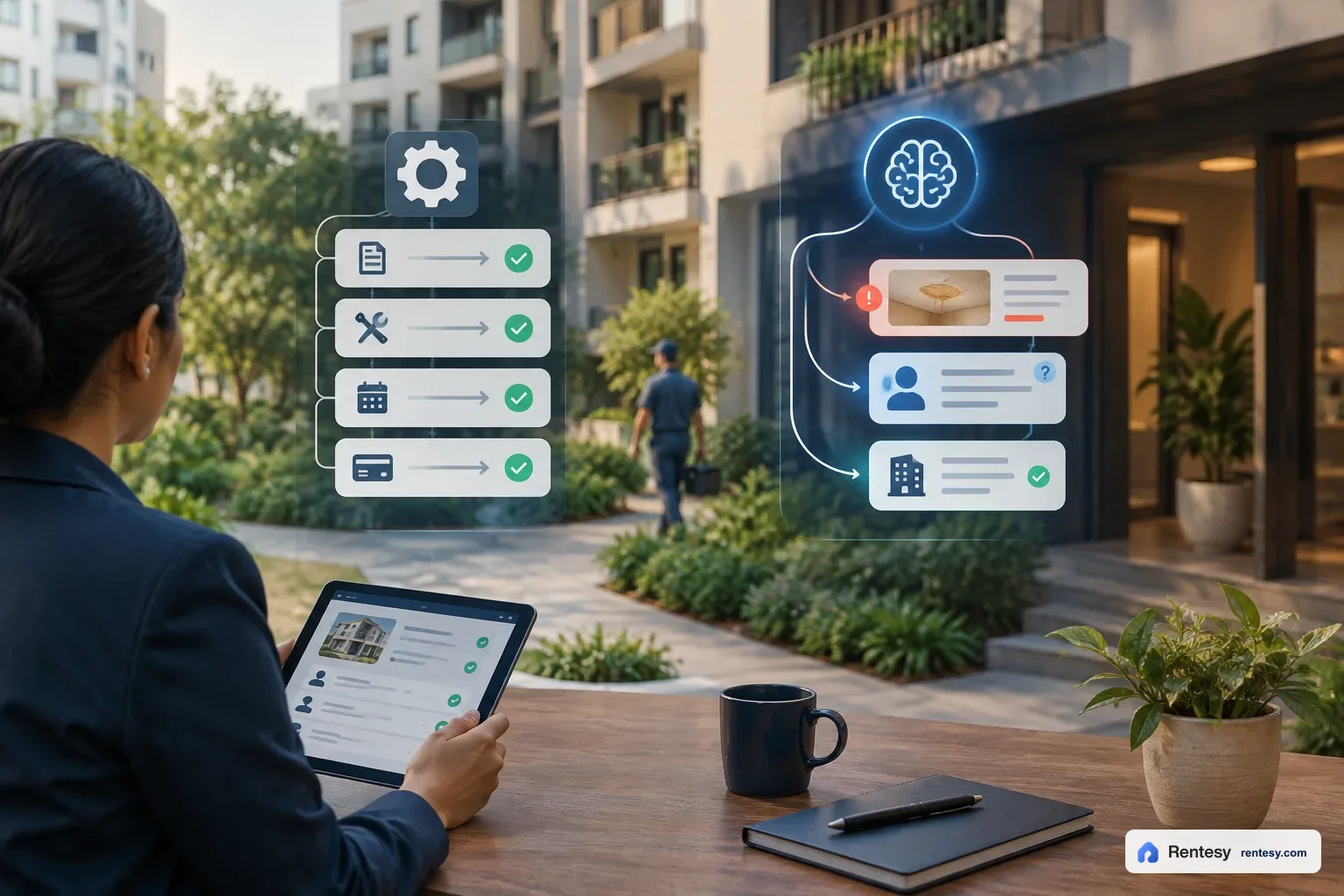
AI & Automation
Agentic AI vs Traditional Automation in Property Management


Property Management
Rental Property Management in India: A Complete Landlord's Guide
See Rentesy in action
Get a personalised 30-minute walkthrough for your portfolio. No commitment, no credit card.
Prefer email? Contact our team